

Writing
Journal d’un citoyen
In 2010, in his fifties, Edouard Vitrant began to take notes. These comments on current events had no specific purpose.
It was simply a matter of fixing the state of his opinion at a specific moment, to keep a record of it.
Nothing predisposed him to write. His job as a designer is a priori far from writing. On closer inspection, the approach of a designer and that of a diarist have certain affinities. Before designing an object, you must think about its use, the people likely to use it, the market context, and its manufacturing conditions. The analysis precedes the drawing, and the drawing will be all the more accurate if the analysis has been synthetic.
The diarist does nothing else. He places events in context, puts them in a certain perspective and adds his two cents. The news he picks up doesn’t always make the headlines. These small pebbles collected according to the mood of the author draw, in an impressionistic way, the landscape of an era.
Bookstore stalls are overflowing with commentaries on public life written by philosophers, sociologists, editorialists or political leaders, elected officials or candidates. The words of the ordinary citizen are almost impossible to find there. It is this gap that Le journal d’un citoyen (The diary of a citizen) fills.
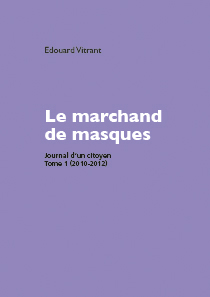
Le marchand de masques
Tome 1 (2010-2012)
Le Journal d’un citoyen is a long-term project. Le marchand de masques (The mask dealer) is its first link in the chain. It covers the period from 2010 to 2012. Throughout the pages, the author records the reflections and comments inspired by current events. The highlights are the Strauss-Kahn affair and the 2012 presidential election campaign. Occasionally, he ventures a suggestion, such as a generational pact. The passage of time allows us to appreciate its relevance. What is written in the heat of the moment is best read with hindsight.
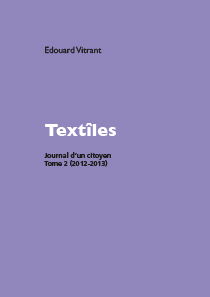
Textîles
Tome 2 (2012-2013)
“What is the use of power without willpower?” is one of the questions asked in this second volume. A bit like those questions a child might ask, whose simplicity can be disarming. Why do we forget to ask ourselves essential questions?
The rise to power of François Hollande provides an opportunity to examine the exercise of power. It was the era of Edward Snowden’s revelations, the placing of Greece under supervision, and the agonizing disintegration of Syria. How long can we remain indifferent? Faced with Russian interventionism, should we boycott the Sochi Olympics?
A few surprises await the reader. They will visit a chicken coop and discover that the Front National advocated surrogacy when all of France was debating same-sex marriage.
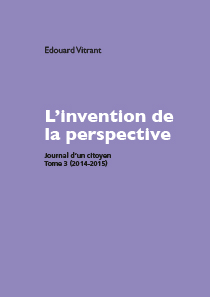
L'invention de la perspective
Tome 3 (2014-2015)
The author continues to question current events by striving to take a step back, to uncover ambiguities beneath the surface, and to shed light on information too quickly dismissed. For example, on November 3, 2014, he notes: “Russia’s military budget is set to increase by… 33% in 2015. 33% is the average rate of increase in the Third Reich’s military budget between 1934 and 1937. No one can say they didn’t know.”
Besides the events in Ukraine, which, from Maidan to the Minsk agreements, occupy a significant place in this volume, other themes recur insistently, such as debates surrounding gender, climate change, and the response to terrorism. It also addresses questions about artificial intelligence and the equally worrying artificial stupidity that risks proliferating in its wake.
Le Journal d’un citoyen is also a language, a tone. This tone becomes somber after January 7, 2015. "I grew up, I matured with Charlie Hebdo. I learned to read and to laugh in Charlie Hebdo. An essential part of myself has been violently torn away. Irony, critical thinking, humor, and impertinence are as necessary as the food we eat or the air we breathe." How can one belong to the human species and hate laughter?
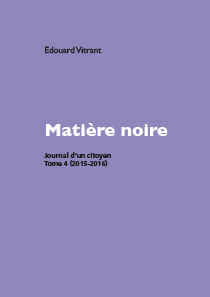
Matière noire
Tome 4 (2050-2016)
We are in the era when a series of attacks struck France, shaking the French people and disrupting the political class. The shockwave led to the adoption of a state of emergency.
The author is astonished. Against the enemies of freedom who are staining our cities with blood, what do political leaders propose? To adopt coercive measures that ultimately restrict the scope of freedoms. Which is exactly what the jihadists want. Beneath the appearance of two opposing discourses, the actions of both sides converge.
The extraordinary nature of this paradox piques his curiosity. And makes him want to take a look at what lies beyond the surface. By digging deeper, he eventually uncovers a buried spring of the human psyche that he calls the "Pandora's complex". Overwhelmed by emotion, an individual disconnects his critical mind and mechanically produces a reaction that runs counter to his own interests and principles.
This Pandora's complex, under the influence of which leaders feel compelled to react to a traumatic event, would be ineffective if it didn't find its counterpart in the mass of bewildered citizens: the Isaac complex. This concept refers to the astonishing docility with which Isaac accepts the fate his father has in store for him, a father who himself blindly obeys a command he forbids himself to question.
The implications of this discovery in the political sphere are considerable. For this era is also the one in which Donald Trump will shake up the Republican primary and sweep the board right under the noses of the party's established figures. This Pandora-Isaac pairing sheds new light on the somewhat perverse alchemy that animates democracies, at the risk of leading to their downfall. Edouard Vitrant warns us, but in this maelstrom where emotion overwhelms reason, who wants to listen to the Cassandras?
This is also the period when an unknown figure bursts onto the political scene: a certain Emmanuel Macron. The author observes the rise of this phenomenon with incredulity, without being fooled by the power plays at the heart of which Macron has positioned himself. Like a seismograph, he records this surge with the blend of lucidity and irony that is his trademark.
This book is like Pandora's box: once opened, it is difficult to close.
Publisher: bookelis.com
Distributor: Hachette